
Mission Grey Daily Brief - July 22, 2025
Executive Summary
The past 24 hours have seen the global political and business environment defined by efforts to escalate the pressure on Russia, dramatic intensification in the Ukraine conflict, increasingly hard-edged trade and diplomatic maneuvering from China, and signs of economic fragility and new risks in both developed and emerging markets. Key highlights include record-breaking aerial assaults on Ukraine, the West doubling down with military and economic aid packages, deepening tensions between India and the U.S. as Washington resets its south Asian posture, China’s escalation of economic leverage tactics against Europe, and prominent signs of stress in both the Russian war economy and the global monetary system. Businesses face a highly fluid risk environment, including new challenges from cybersecurity, sanctions, monetary policy, and supply chain vulnerabilities.
Analysis
1. Ukraine: Escalating Warfare, Sanctions, and Aid Deadlines
The headline development is Russia's largest missile and drone assault on Kyiv in months, occurring just hours before crucial NATO meetings on arming Ukraine and as President Trump's administration and allies put forward a "50-day deadline" for Russia to agree to a ceasefire or face even more draconian sanctions. The attack killed at least two and wounded dozens, igniting fires in residential, industrial, and public spaces, and straining already-exhausted Ukrainian air defenses. The West's response is a coordinated drive—led by the U.S., UK, and Germany—to accelerate the shipment of advanced defense systems, notably Patriot missiles, and step up financing for Ukraine using frozen Russian assets. Britain and the EU tightened the screws with new sanctions directly targeting Russia's critical oil shipping "shadow fleet," cutting annual flows estimated at $24 billion, and lowering the oil price cap to drain further billions from Russia’s war chest [World News | UK...][Donald Trump de...][Russia's high m...].
For international businesses, this signals a likely rise in sanctions compliance risks, potential secondary sanction spillovers (notably for Indian, Turkish, and UAE refiners re-exporting Russian crude derivatives), and the urgent need to audit supply chains for exposure to both Russian and Ukrainian disruptions [Bad news for In...]. Russia's war spending and massive recruitment bonuses are reaching unsustainable levels, fueling inflation and putting long-term macroeconomic stability in jeopardy [Russia's high m...]. If Moscow cannot achieve a breakthrough by autumn, the risk of sudden policy lurches—including forced asset seizures or snap capital controls—will climb.
2. China’s "Hardball" Diplomacy and Heightened Risk for Western Firms
Simultaneously, China is setting a combative tone for its upcoming summit with EU leaders, firmly retaliating against Western trade curbs, slowing key exports, and deepening its strategic embrace of Russia. Beijing has retaliated over European tariffs on electric vehicles by limiting critical mineral exports and has explicitly linked improved bilateral ties to Europe's willingness to roll back restrictions. China is betting on Europe’s desire for market access and is exploiting perceptions of weakening transatlantic unity, particularly as U.S. foreign policy tilts further into “America First” territory [China’s Hardbal...].
Western businesses are seeing a tangible escalation in risk. The recent detainment of Wells Fargo personnel and a U.S. Commerce Department contractor in China—both barred from leaving the country—has led several multinationals to suspend non-essential travel to China outright [Support for Tru...]. These incidents spotlight the mounting risk of exit bans, regulatory retaliation, and potential hostage diplomacy, particularly for firms with U.S. links or employees of dual nationality. Companies must re-examine their local personnel policies and contingency plans for China exposure, while broader supply chain diversification—especially away from sectors vulnerable to state interference—remains a prudent move.
3. India-U.S. Strains, China Reset, and Currency Volatility
A rare, high-level meeting between President Trump and Pakistan’s military chief has provoked outrage in New Delhi, compounding tensions after recent India-Pakistan border clashes. India has protested vigorously, fearing renewed U.S. military aid to Pakistan and a diminished strategic relationship with Washington. This U.S. outreach to Islamabad is prompting New Delhi to consider rolling back restrictions on Chinese investment, underscoring how global businesses can be squeezed as major powers recalibrate alliances [Trump-Munir mee...].
The broader economic backdrop for India is increasingly complex. The rupee has slid toward a historic low against the dollar, pressured by global outflows, rising oil prices, and fears of U.S. tariffs on Indian exports if trade talks fail. India’s $15 billion annual petroleum exports to the EU face jeopardy as new European sanctions prohibit imports of refined products linked to Russian crude, threatening a pillar of India's external account [Bad news for In...][Rupee weakens a...]. Market participants remain on edge, with policymakers eyeing interventions and efforts to court new trade partners and investment as stabilizing measures [Rupee weakens a...].
4. Macro Risk: Fiscal Strain, Policy Dilemmas, and Cyber Threats
On the broader economic front, the Congressional Budget Office has delivered stark warnings that President Trump’s latest tax and spending package will add $3.4 trillion to U.S. deficits through 2034, leaving more than 10 million people uninsured [Budget office s...]. These projections are already feeding political battles over the fiscal sustainability of U.S. policy and global investors’ willingness to continue financing American debt. The Federal Reserve is also facing mounting political delays over rate cuts as jobs data signal softness beneath the surface, particularly in the small business sector [Fed Should Act ...].
Meanwhile, a rising tide of cybersecurity risk continues to challenge global enterprises. India has launched a sweeping national cyber defense exercise, while survey data reveals that up to 91% of IT and security leaders are making routine compromises, trading-off visibility and integration for agility in an era of hybrid cloud and AI [The risk we cho...][Business News |...]. This operationalization of compromise increases the risk of undetected breaches and fundamentally challenges the resilience of digital business models worldwide.
Conclusions
The global landscape is at a pivotal moment, with geopolitical and economic factors pressuring governments, companies, and investors to rethink long-standing strategies and prepare for rapid shifts. The escalation in Ukraine, China’s diplomatic brinkmanship, U.S.-India-Pakistan tensions, and the deepening risks in the Russian and global economies all signal a period of heightened volatility and unpredictability.
How can businesses most effectively balance resilience and risk, especially as visibility into complex global supply chains and digital systems becomes ever more challenging? Will new alliances lead to greater stability, or simply reshape where and how risks materialize? For firms seeking to thrive in the free world, decisions about where and how to invest—and whom to trust as partners—will increasingly be shaped by values, transparency, and robust contingency planning.
Stay tuned, and keep your risk radar sharp.
Further Reading:
Themes around the World:

Blockade Crimps Oil Exports
The US naval blockade and secondary sanctions have halted or sharply curtailed Iranian crude shipments, with reports of no new terminal loadings since mid-August and dwindling oil at sea. Export receipts, counterparties, and energy-linked supply chains face immediate disruption.

Hormuz Shock And Costs
FBR attributed an estimated Rs144 billion revenue shortfall to a Strait of Hormuz blockade, citing fuel-price increases and slower activity. Shipping or energy shocks could raise landed costs, disrupt planning and amplify fiscal or currency pressures. [pbdF]

Project Approvals And Labour Risks
Bill C-39 proposes one-year federal reviews, specialized project regulators and national-interest zones, potentially accelerating infrastructure approvals. It also revises collective-bargaining processes amid concerns over strikes and environmental and Indigenous scrutiny, creating both schedule opportunities and legal-social execution risks.

United States Tariffs Reshape Export Economics
U.S. surcharges of 25% and 12.5% expose some Brazilian goods to combined rates of 37.5%; 16.5% of exports to the U.S. are affected. Machinery, wood, footwear, furniture and apparel face pricing, market-access pressure and order volatility.

India-Russia Oil Trade Under Threat
India imported about 2.08 million barrels per day of Russian crude in August, roughly 45% of total imports, after July shares neared 56%. Potential U.S. tariffs could force refiners toward costlier alternative grades and higher freight bills.
Export Infrastructure Shapes Market Access
A proposed West Coast pipeline costing an estimated $35.2–43.7 billion could move more than one million barrels daily toward Asia-Pacific markets, while rail and port investment supports energy and grain exports. Delays would constrain diversification and producer expansion.

Supply Chain Diversification Accelerates
Taiwan is widening external links as Canada delays signing its trade framework and Manila keeps economic ties open. Officials also cite a sharp drop in investment dependence on China. For firms, this signals new opportunities and a stronger diversification push.

Energy Security Shapes Investment
Vietnam's push into advanced manufacturing, data centres and semiconductors is expected to intensify power demand. Canadian and Danish cooperation discussions highlight renewables, offshore wind, LNG and energy security; reliable, cleaner supply is important to project economics and investor selection. [Ln5j; SVA2]

Crude Allocation Shifts
Aramco reportedly reduced September–October crude deliveries to some European refiners while prioritizing Asian buyers. It also arranged approximately 60 million barrels for shipment through Hormuz to Oman for transfer, changing regional availability and procurement assumptions.
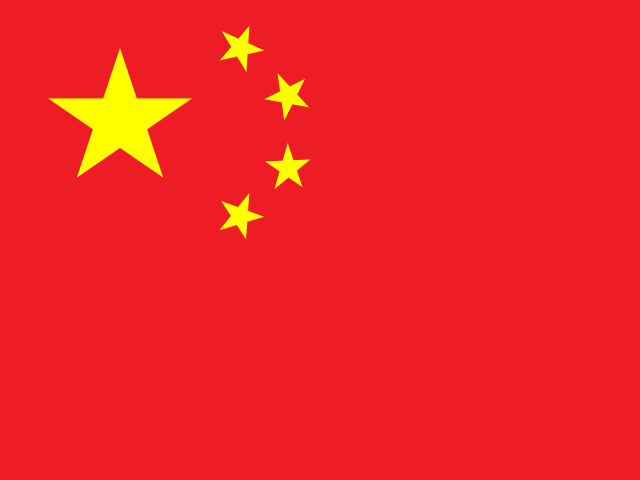
Iran War and Energy Risk
The Iran conflict is disrupting oil flows and shipping lanes, directly affecting China as Iran’s biggest oil customer. US sanctions pressure on Chinese banks and energy buyers could ripple into refining margins, freight costs, and broader compliance exposure for global firms.
Oil Dependence and Evasion Networks
China absorbs an estimated 90% of Iran’s crude exports, providing a critical revenue channel despite sanctions. Front companies, intermediaries and shadow-fleet vessels obscure cargo ownership and origin, creating heightened due-diligence and counterparty risks for maritime businesses. [7EWG][Xti7]

U.S. Investment Pledge Reshapes Trade
Japan’s $550-billion investment pledge to the United States was discussed alongside tariff reductions, positioning Japanese firms to expand U.S. capacity. The arrangement could redirect capital and production, but execution terms and political expectations will shape returns and future market access.

Alternative Export Routes Constrained
Ukraine's alternative rail, Danube and road corridors cover only about half of export demand, against a stated need of five million tonnes monthly. Congestion, low river levels and limited border throughput constrain recovery and raise delivery costs.

Technology Controls Trigger Retaliation
FCC restrictions block new foreign-made advanced robots and power inverters from import, marketing, or sale absent federal approval; Beijing retaliated with drone export curbs and measures against US firms. Technology sourcing and market access now carry elevated geopolitical exposure.
War And Security Uncertainty
Frontline combat and long-range strikes remain active, while proposed energy and grain protections have not produced a settlement. Persistent uncertainty complicates market entry, asset valuation, personnel security, contract enforceability and the timing of reconstruction commitments.
Buy National Procurement Expands
Canada’s Buy Canadian policy prioritizes domestic firms, Canadian steel, aluminum and wood in major federal projects, while Washington ordered agencies to remove Canadian-origin products from procurement. The two-way tightening threatens access to large public contracts and vendor selection.

Freight, Insurance, and Fuel Inflation
Diversions around Africa add 6,500-7,000 kilometers and 10-14 days per voyage, lifting bunker, supply, and insurance costs. The result is higher landed costs for imports, weaker export competitiveness, and broader inflation pressure across regional supply chains.

Bilateral Tensions Raise Operating Uncertainty
Targeted U.S. visa restrictions and warnings of further escalation deepen bilateral uncertainty, even as Pretoria seeks dialogue. Although measures are not blanket sanctions, affected officials and policy disputes could complicate travel, government engagement, and investor assessments of political risk.
Fragile US-China Trade Détente
Washington and Beijing extended their truce to January 10, 2027 and agreed reciprocal tariff relief on roughly $30 billion of non-sensitive goods each way. The short runway and unresolved strategic disputes keep sourcing, pricing and contracting exposed to renewed escalation.
Buyer Concentration Creates Supply Risk
The disruption exposed buyer concentration: Saudi crude reportedly supplied about 40% of Polish refiner Orlen’s oil needs, prompting it to seek North Sea and other alternatives. Importers should reassess supplier concentration, contract flexibility, inventories and contingency sourcing.
Investment Access Faces New Constraints
The Graham Act codifies a prohibition on new US investment in Russia and its energy sector, while Vostok’s development continued after Vitol and Trafigura withdrew. Foreign investors face legal exposure, financing gaps, and heightened exit and due-diligence risks.

Automotive Supply Chain Exposure
The UK–EU automotive relationship is worth about €80 billion annually, with deeply interdependent component flows and the EU serving as the UK’s largest passenger-car export market. Any exclusion or demand shock could affect production scale on both sides.
Aviation Restrictions Disrupt Business Operations
US measures against Iranian airlines and service providers reportedly suspended over 80–90% of international flights; threats against facilitators and Iranian warnings to neighboring airports complicate executive travel, air cargo, maintenance support and cross-border logistics planning.
Tariff Escalation Raises Reciprocity Risk
Washington’s additional tariffs of 25% and 12.5% on Brazilian goods, lifting some products to 37.5%, are now central to commercial planning. Lula said Brazil may use its Reciprocity Law if talks fail, increasing uncertainty for exporters and importers.
Energy Shock Hits Supply Chains
War-related oil disruptions pushed crude above $100 and diesel to record highs above $6.30 a gallon, with shipping lanes in the Strait of Hormuz and Red Sea under pressure. Freight, farming, and distribution costs are rising across supply chains.

Nickel Dominance Reshapes Supply Chains
Indonesia supplies 60–65% of global nickel, giving policy and operational disruptions outsized influence over prices and downstream supply. Tightened mining quotas, proposed tax increases and Chinese-linked processing partnerships heighten investor exposure to regulation, concentration and market volatility.
Oil Sanctions Evasion Risks
Shadow-fleet tankers and ship-to-ship transfers keep Russian crude moving despite price caps, but strikes and enforcement pressure disrupt routes; August seaborne exports fell 21% and revenues 32%. Buyers, insurers and intermediaries face heightened sanctions, safety and settlement exposure.
IMF Review And Financing
Fourth EFF and third RSF reviews are underway; approval could unlock about $1.2 billion against $8.4 billion programmes. Continued funding, market confidence and external liquidity for firms and investors depend on targets and sustained reform delivery. [6Fl1, pbdF]
Reform Legislation And Execution
The IMF programme reportedly entails 174 legislative amendments spanning taxation, energy, privatisation and governance. Parliament retains approval authority, creating implementation and timing uncertainty for businesses anticipating changes to market rules and public-sector frameworks.

Budget Passage and Political Risk
France’s fragmented parliament and threatened censure motions make budget adoption uncertain ahead of the 2027 presidential election. Previous prime ministers fell over budget disputes; prolonged negotiations could delay fiscal decisions and leave businesses facing shifting rules and confidence risks.

India's Manufacturing Capability Gap
PLI investment crossed ₹2.40 lakh crore, yet manufacturing was 14.8% of GVA in 2025–26. This gap exposes limits of incentives and factories without deep supplier networks, tooling, skills and testing; investors should assess local value addition and cluster depth.
Rising Debt-Service Exposure
Public debt is projected at 119.3% of GDP in 2026 and 121.7% in 2027; debt interest could rise from €65 billion in 2026 to €100 billion by 2030. Higher financing costs increase fiscal and sovereign-risk sensitivity.

Trade Corridors And Logistics Investment
Ankara is positioning the Middle Corridor and Development Road as routes linking Asia and Europe and the Gulf with Europe, respectively. Planned transport and energy links, alongside regional reconstruction, could create opportunities but remain exposed to regional instability.
AI Chip Curbs Deepen
Congress is moving to restrict advanced AI chip exports to China through the NDAA, with tracking and tougher review provisions. Nvidia and other suppliers face revenue pressure, while Huawei and Chinese rivals accelerate domestic silicon development and substitution.

Record Semiconductor Export Surge
Semiconductor exports reached a record in September’s first 20 days, rising 259% year over year, with forecasts pointing to a sharply wider trade surplus. The momentum supports earnings and investment, but increases exposure to chip-cycle volatility and concentrated demand.
New Exit Rules Raise Mobility Risk
China’s new rules allow authorities to bar citizens from leaving over certain export-control or technology-transfer violations. Effective September 15, the provision creates uncertainty for staff rotations, overseas assignments, joint R&D and executive travel at multinationals.