
Mission Grey Daily Brief - September 02, 2024
Summary of the Global Situation for Businesses and Investors
Russia's invasion of Ukraine continues to be a dominant theme, with ongoing conflict causing a severe humanitarian crisis in both countries. Meanwhile, the situation in Iran is deteriorating, with the government cracking down on nurses' protests and media freedom. In Germany, the right-wing Alternative for Germany (AfD) party is expected to win its first election, and in Azerbaijan, there are concerns about the government's human rights abuses and greenwashing ahead of COP29.
Ongoing Conflict in Ukraine
Russia's unprovoked invasion of Ukraine in February 2022 continues to cause widespread devastation and a dire humanitarian crisis. Recent Russian attacks on Kharkiv, Ukraine's second-largest city, have resulted in civilian casualties and infrastructure damage. Ukraine has also conducted a surprise incursion into Russia's Kursk region, capturing about 500 square miles of Russian soil. This changes the outlook for potential negotiations, but Russian leader Vladimir Putin remains committed to continuing the war. The international community is calling for all parties to respect international humanitarian law and allow unhindered access for aid organizations.
Deteriorating Situation in Iran
The situation in Iran is causing concern, with the government cracking down on peaceful protests by nurses over poor working conditions. There are also increasing worries about the Pezeshkian government's handling of various issues, including inequality, media freedom, and access to the internet. Iranian authorities have been accused of unjustly arresting and sentencing peaceful protesters, and the Biden administration is closely monitoring the situation. Additionally, there is alarm over the treatment of journalists, with editors of the Stand News outlet recently found guilty of sedition charges.
Germany's Right-Wing Party Gains Traction
Germany's right-wing Alternative for Germany (AfD) party is expected to win its first election since its formation in 2013, benefiting from rising anti-mass immigration sentiment. Exit polls show the AfD securing a substantial share of the vote in Thuringia and Saxony, while the center-left Social Democratic Party brought in less than 8%. This follows a wider trend of success for conservative groups across Europe. The impact of the AfD's win will depend on the willingness of centrists to work with them. The election comes just days after a Syrian immigrant carried out a terrorist attack in Solingen, Germany, killing three people.
Azerbaijan's Human Rights Abuses and Greenwashing
Azerbaijan is facing criticism for its human rights record and greenwashing efforts ahead of the COP29 Climate Summit, which it will host this year. There are reports of the detention and mistreatment of outspoken critics of the government, including academic Dr. Gubad Ibadoghlu, who has been arrested and denied medical assistance. Additionally, Azerbaijan's human rights record has significantly worsened since being announced as the host of COP29, with journalists and activists facing arrest and criminal prosecution. There are concerns that the government is delaying trials until after the summit to avoid international scrutiny.
Risks and Opportunities
- Risk: The ongoing conflict in Ukraine and Russia's attacks on civilian infrastructure pose significant risks to businesses and investors, especially those operating in the region.
- Risk: The deteriorating situation in Iran, including the government's crackdown on protests and media freedom, creates an unstable environment that may deter investment and business operations.
- Risk: The rise of right-wing politics in Germany and across Europe could lead to policy changes that may impact businesses, particularly those related to immigration and deportation laws.
- Opportunity: Azerbaijan's hosting of COP29 presents an opportunity for businesses and investors to engage in discussions around climate action and green initiatives. However, the country's human rights record should be carefully considered when exploring potential opportunities.
Further Reading:
- Sudan Tribune - Sudan Tribune
A photographer traveled 10,000 miles through Ukraine. This is what he saw - CNN
After Ukraine Strikes Russian Energy Facilities, Russia Bombards Kharkiv - The New York Times
Experts express alarm over Pezeshkian government's behavior - ایران اینترنشنال
Germany's right wing poised for major wins as centrist parties stumble - Fox News
Good Cop, Bad COP29: Azerbaijan's greenwashing ahead of crucial climate summit - SBS News
History Shows Giving Land to Russia Won't Bring Peace in Ukraine - Foreign Policy
Themes around the World:

Suez Canal Route Volatility
Regional conflict has made Suez Canal traffic highly volatile. April revenue reached $419 million, up 27% year on year, yet Egypt previously estimated roughly $10 billion in lost canal income, while new transit surcharges from July raise shipping costs and planning uncertainty.

Automotive transition under strain
Germany’s automotive base is under heavy pressure from EV transition costs, Chinese entrants, and weak supplier finances. In a VDA survey, 54% of suppliers were cutting jobs and 41% reported poor conditions, threatening domestic production capacity, innovation, and procurement reliability.
Auto Transition Drives Relocation
Germany’s automotive transition is accelerating restructuring, foreign investment shifts and supplier stress. A VDA survey found 41% of suppliers rate conditions as poor, 54% are cutting jobs, and the sector could lose 225,000 positions by 2035 as EV competition intensifies.

Platform labor rules tightening
A new ILO convention could influence Brazil’s postponed regulation of app-based work, affecting roughly 2 million workers. Possible future rules on social security, pay transparency, algorithm disclosure and worker classification would raise compliance obligations for digital platforms and outsourced service operators.

Labor Compliance And Saudization Tightening
Saudi authorities are refining labor-market rules through Qiwa and intensifying enforcement on residency and employment violations. Premium Residency holders now need dedicated work permits, while weekly crackdowns detained 7,760 violators, underscoring compliance, workforce planning, and contractor-screening risks for foreign companies.

Energy Security Gains Importance
India-US discussions increasingly connect trade with energy security, including larger Indian purchases of US energy products. For business, this strengthens prospects in hydrocarbons, equipment, shipping, and industrial inputs, while also highlighting exposure to external price shocks and maritime disruption risks.

Tighter Immigration and Entry Controls
Thailand is tightening border screening through digital pre-clearance, a blacklist of 169,506 names and stricter visa enforcement, with nearly 30,000 entries denied this year. Businesses may benefit from stronger compliance, but tourism, expatriate mobility and staffing flexibility could face added friction.
Social Unrest and Logistics Disruption
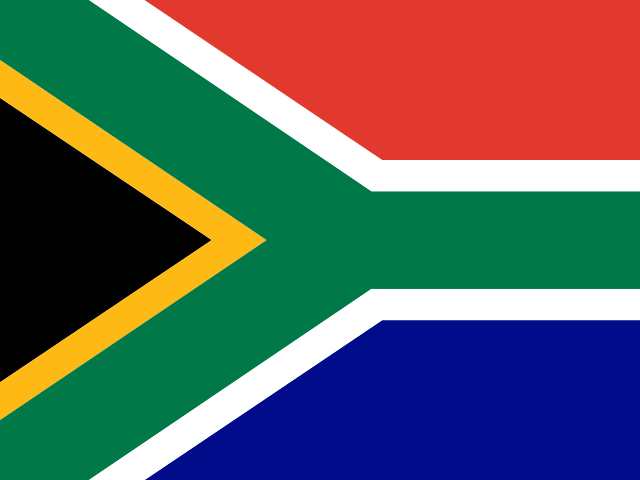
Planned anti-immigration protests in Gauteng and KwaZulu-Natal have renewed concern over unrest. Security assessments warn of road blockages, delivery delays, business shutdowns and looting, echoing the 2021 riots that caused about R50 billion in losses and 354 deaths.
Labor Market Tightening and Saudization
New Qiwa rules cap instant work visas (five for new firms, up to 50 for established ones) and tie allocations to Saudization tiers. Mass deportations exceeded 11,000 weekly. Reforms reshape expatriate recruitment costs and workforce planning for foreign businesses.

Won Volatility Pressures Operations
The won has weakened sharply despite strong external accounts, prompting Seoul and Washington to coordinate on currency stability. While April posted a $28.29 billion current-account surplus, exchange-rate swings still complicate import costs, treasury planning, hedging decisions and foreign-investor confidence.

Sovereign AI and Digital Regulation
Canada’s new AI strategy includes roughly C$2.3 billion in support, a public AI supercomputer and stronger digital-sovereignty ambitions. While this may attract technology investment, evolving privacy, data-control and platform rules will increase compliance complexity for multinational digital and cloud operators.
Europe trade defense escalation
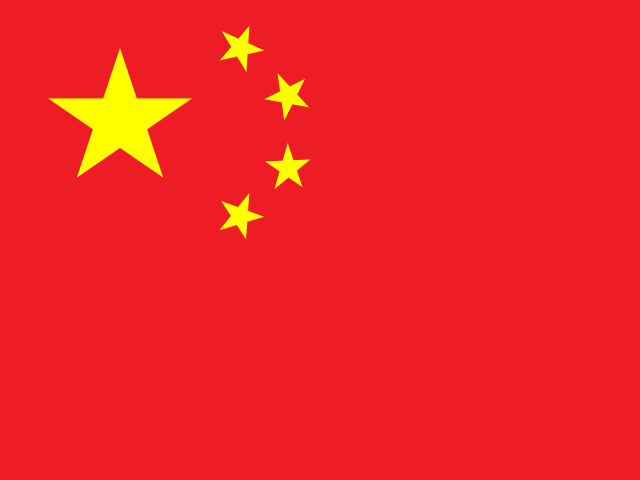
China’s record export surplus is intensifying backlash in Europe, where exports to the EU rose 16.4% in January-May and the 2025 EU goods deficit reached €360.6 billion. More tariffs, quotas, and anti-subsidy actions would materially reshape market access and location strategies.

Market volatility and currency swings
Israeli assets have turned sharply more volatile. The TA-35 fell more than 12% in dollar terms in June, the broader exchange roughly 20% over the past month, and the shekel about 3.1%, complicating hedging, valuation, import costs, and capital-allocation decisions.
Pre-salt funds face competing demands
Use of pre-salt social fund resources for subsidized rural refinancing highlights growing competition for strategic fiscal resources. This can reduce room for infrastructure, climate adaptation, and social investment, affecting long-term project pipelines relevant to ports, energy, transport, and regional development.
Energy Security And Power Expansion
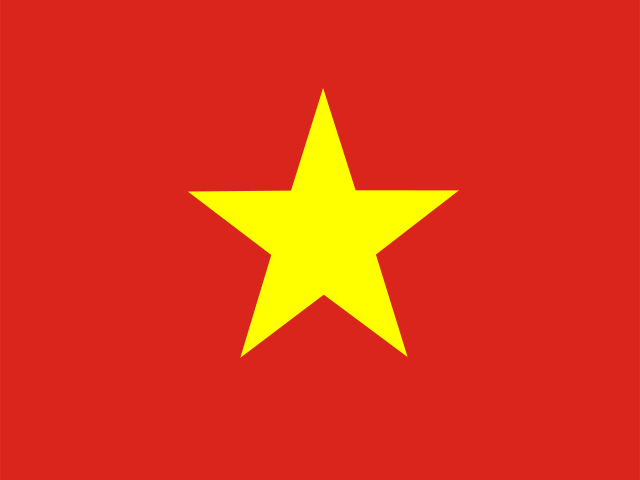
Reliable power remains a strategic business issue as Vietnam expands LNG, grid connectivity and regional energy cooperation. Projects such as the over US$2.2 billion Quynh Lap LNG power plant should improve supply, but delays, transmission constraints and demand growth still threaten industrial continuity.
Energy Security and Import Dependence
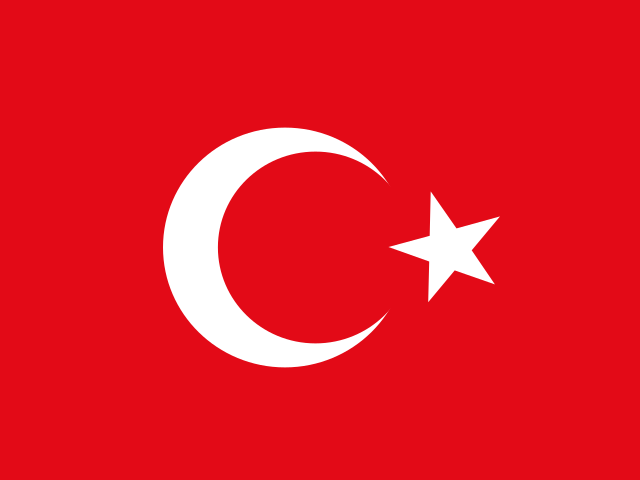
Energy remains a core business risk and opportunity. Turkey’s 2022 energy import bill reached about $100 billion, while Black Sea gas now supplies four million households and production is set to double this year, supporting medium-term resilience but not eliminating current import sensitivity.
Logistics and Industrial Platform Upgrades
Cabinet approvals for a new economic entities platform, food-focused dry port licensing, and planning regulations point to a broader push to improve logistics and business administration. If implemented effectively, these reforms could reduce transaction frictions and strengthen Egypt’s trade-hub positioning.
Strategic Supply Chain Stockpiling
Japan is pushing coordinated G7 stockpiling of critical minerals and aiming to reduce dependence on any single supplier to below 60% by 2030. This supports resilience planning but may raise near-term inventory costs, supplier qualification demands and compliance requirements for manufacturers.

USMCA Review and Tariff Uncertainty
Washington’s decision not to renew USMCA for another 16 years pushes North American trade into annual reviews, while auto and steel side talks continue. With nearly US$2 trillion in regional trade exposed, investors face prolonged policy uncertainty and supply-chain recalibration.

Election-driven policy uncertainty rises
With the 2027 presidential campaign already shaping debate, reform capacity is weakening and business planning horizons are shortening. Pre-election positioning may delay structural decisions on taxation, labor, spending, and industrial strategy, increasing wait-and-see behavior across investment and hiring.

Gas Reservation Disrupts LNG
Canberra’s proposed gas-reservation scheme could divert up to 20% of LNG export volumes to domestic users from 2027, unsettling Japanese, Korean and Malaysian investors and raising contract, pricing and sovereign-reliability concerns for energy-intensive trade, manufacturing and project finance.
Agronegócio e meio ambiente
O agronegócio segue central para exportações, mas enfrenta maior escrutínio sobre desmatamento ilegal e trabalho forçado. Questões socioambientais já aparecem em disputas comerciais, elevando exigências de rastreabilidade, due diligence e governança para exportadores e investidores estrangeiros.
Regional Supply Chain Realignment
Vietnam is deepening economic ties with ASEAN partners such as Thailand and the Philippines while positioning itself as a diversification hub beyond China. This supports electronics, agriculture and digital trade flows, but also intensifies competition for export share, skilled labor and multinational capital.
Riyadh Air Hub Expansion
Riyadh Air’s launch marks a major push to make Riyadh a global transport and business hub. Backed by the $900 billion PIF, the carrier targets 100-plus cities and supports wider airport expansion, improving connectivity while exposing aviation plans to regional security shocks.

B50 Biodiesel Reshapes Trade
Mandatory B50 biodiesel starts 1 July 2026, with government projecting Rp157.28 trillion in FX savings, Rp24.68 trillion in palm oil value added, and 2.21 million jobs. The policy should cut diesel imports, but may tighten palm oil balances and affect food-energy pricing.
Rail Strikes and Logistics Disruption
Nationwide SNCF strikes canceled about one-third of TGV services and half of Intercités trains, while regional traffic was heavily disrupted. Labor tensions over restructuring, competition and wages create recurring transport risk for business travel, commuter reliability and time-sensitive domestic supply chains.
North Korea Tensions Persist
Pyongyang vows accelerated nuclear buildup and treats Seoul as a hostile state, stalling Lee's dialogue push despite phased-approach talks with Trump; border fortification and armistice disputes sustain geopolitical risk for investors.
Social Cost Shifts For Employers
Planned reductions in public health reimbursement could transfer costs to supplementary insurers and employers, while authorities seek broader social-security savings. Companies may face higher benefit expenses, pressure on household purchasing power, and renewed labor sensitivity around compensation and employment conditions.
Sticky Inflation, Hawkish Fed
The Federal Reserve held rates at 3.5%-3.75% and signaled possible hikes despite falling oil, as strong retail sales and AI-related investment keep inflation elevated, suggesting higher-for-longer borrowing costs affecting investment decisions.
Digital Infrastructure And AI Race
Saudi Arabia is positioning itself as a regional AI, digital infrastructure, and advanced technology hub. Expanding investment in data, 5G, AI, and space is attracting partners, but firms must navigate intensifying U.S.-China technology competition, standards fragmentation, and strategic supplier-selection risks.

External Financing Anchors Stability
Ukraine remains heavily reliant on EU and IMF support to sustain macroeconomic stability, budget execution, and reconstruction planning. The EU has disbursed over €29.4 billion under the Ukraine Facility, while the IMF’s $690 million review supports reforms despite slower implementation and weaker growth forecasts.
State Export Control Expands
The new single-gate export model under PT DSI for coal, palm oil, and ferroalloys centralizes trade oversight from June 2026, with full rollout by January 2027. It may improve transparency, but adds compliance complexity, political risk, and potential WTO-related trade frictions for exporters.
Opposition Crackdown, Rule-of-Law Risk
Escalating action against CHP politicians, mayors, and civil society is deepening concerns over judicial independence and policy predictability. The European Parliament has discussed sanctions on Turkish officials, raising reputational, governance, and long-term investment risks for companies requiring strong legal protections.

Infrastructure and Gulf Investment Push
Pakistan is actively courting Saudi and other foreign capital in ports, logistics, energy, and urban infrastructure, including a proposed 140-acre Karachi maritime business district. This supports medium-term project pipelines, but delivery still depends on approvals, financing clarity, and governance credibility.
US tariff pressure reshaping investment
Proposed US tariffs of 25% on EU cars could add about €2.5 billion annually to Germany’s auto production costs. The pressure favors localizing manufacturing in North America, especially for brands with limited US capacity, and may redirect future capital expenditure abroad.
Agricultural Disease and Export Losses
The foot-and-mouth outbreak has become a material agribusiness risk. Reports indicate a 26% drop in total beef exports, a 69% fall in shipments to China and roughly R5.6 billion in export revenue losses, damaging farming, food processing and rural logistics.