
Mission Grey Daily Brief - October 12, 2026
Executive summary
The clearest message from the past 24 hours is that energy stress is no longer a sector story; it is becoming the organizing principle of geopolitics, inflation, and trade. The Strait of Hormuz remains severely disrupted, with commercial traffic still roughly 75% below normal in recent reporting, Brent holding above $100, and China now halting new fuel export licences in a move expected to cut its October refined-fuel exports by about 40%. At the same time, Washington’s attempt to engineer an “energy ceasefire” between Russia and Ukraine appeared to unravel almost immediately, underscoring how fragile any market-friendly diplomatic shortcut remains. Into that backdrop, finance ministers and central bankers are gathering in Bangkok with the IMF and World Bank warning that energy costs, debt burdens, and climate risks are converging rather than easing. [1] [2] [3] [4]
For business leaders, the practical implication is straightforward: the global economy is entering another phase in which physical supply constraints, political interventions, and price transmission are moving faster than formal policy frameworks can adapt. In the United States, headline CPI is expected to accelerate to about 3.7% while core inflation is seen holding near 2.4%, leaving the Federal Reserve to judge whether the current energy shock is temporary noise or the start of a broader re-pricing cycle. Meanwhile, tariffs are again showing up as a direct cost issue for manufacturers, with firms reporting multi-million-dollar annual hits and container surcharges running into the thousands of dollars. [5] [6] [7]
Analysis
Energy insecurity is widening from the Gulf to Asia
The Middle East remains the primary source of global volatility. Recent reporting points to continued maritime danger around the Strait of Hormuz, including vessel strikes, heavy rerouting, and commercial shipping volumes still running well below pre-conflict levels. This matters because the strait is not just symbolically strategic: the IEA says nearly 15 million barrels per day of crude, or roughly 34% of global crude oil trade in 2025, moved through it. In parallel, Saudi-backed operations against Houthi targets in Yemen and attacks linked to Iranian-aligned actors are keeping the insurance, freight, and risk premium embedded in global energy prices. [1] [2] [8] [9]
What changed meaningfully over the weekend is that Asia is no longer acting as a stabilizer. China has suspended new fuel export licences indefinitely, prioritizing domestic energy security. One report expects Chinese fuel exports to drop 40% in October; another notes that China accounted for 8% of global diesel, gasoline, and jet fuel exports in September. The same reporting suggests Chinese fuel stocks have fallen by 65 million barrels since the start of the war, while spot freight costs for crude moving from Oman to China have surged from about $1.50 per barrel at the start of the year to $36. In other words, one of the few large-scale shock absorbers in refined products is now pulling inward, which is exactly the opposite of what a tight diesel market needs. [3]
The business implication is that this is shifting from an oil-price problem to a diesel-and-logistics problem. Diesel is the fuel of freight, agriculture, mining, backup power, and heavy industry. When diesel tightens, the inflation impulse broadens far beyond petrol stations. Companies with exposure to shipping, chemicals, industrial metals, and food processing should assume that transport premia, working-capital needs, and supplier behavior will stay unstable even if crude itself does not make a dramatic upward break from here. China’s opaque, state-directed inventory management is now an external market variable in its own right. [3] [4]
The Russia-Ukraine “energy ceasefire” exposed the limits of transactional diplomacy
The other major development was the attempted launch of an energy ceasefire between Russia and Ukraine. President Trump announced that both sides had agreed to stop hitting energy infrastructure, but President Zelensky said the arrangement was “news” to him and added that Ukraine would comply only if Russia did the same. Within hours, Ukrainian officials reported Russian strikes on power facilities in Kyiv and Kharkiv, casting immediate doubt on whether any operational ceasefire existed at all. Zelensky said Russia had carried out more than 200 strikes on Ukraine’s electricity generation and transmission facilities in the previous week, plus 17 attacks on gas and oil sites, leaving more than 150 dead and over 700 injured. [10] [11] [12]
The wider significance is not only military; it is commercial and political. Washington has paired pressure on Kyiv to stop refinery strikes with a temporary easing of restrictions on Russian diesel, including an announced flow of more than 300,000 tonnes immediately and another 500,000 tonnes in November. That may offer some short-term relief to fuel markets, but it also creates a deeply awkward alliance dynamic: the United States is effectively asking Ukraine to stop attacking one of Moscow’s most economically sensitive targets while Europe is moving in the opposite direction, publicly defending Zelensky and preparing additional sanctions. That divergence raises a broader strategic question for companies: if sanctions policy is now being used tactically to manage voter fuel prices, how durable are existing assumptions about Western policy coherence? [13] [14] [11]
For Europe in particular, the timing is poor. Winter risk is approaching, Ukraine’s grid remains vulnerable, and any perceived monetization of Russian energy capacity without reciprocal security guarantees for Ukraine would signal that price stabilization is taking precedence over deterrence. That may calm some spot-market pressures, but it weakens confidence in longer-horizon policy consistency—a serious issue for energy traders, insurers, lenders, and manufacturers deciding whether to hedge for six weeks or six quarters. [11] [14] [15]
Bangkok’s IMF meetings open under the shadow of an energy-and-debt squeeze
Against this backdrop, the IMF-World Bank meetings opening in Bangkok look less like a routine multilateral gathering and more like an emergency checkpoint for the global economy. World Bank President Ajay Banga and IMF Managing Director Kristalina Georgieva have both warned that rising diesel and fertilizer costs, climate risks, and heavy debt loads are colliding. Current IMF signalling suggests global growth may still hover around 3% in 2026, but the headline masks severe asymmetry: developing economies are far more exposed to capital outflows, refinancing stress, and imported inflation. The IMF says global public debt is already at its highest level since World War II and is on track to exceed 100% of GDP before 2030, while interest payments in developing countries are already consuming more than 10% of government revenue on average. [4] [16]
That macro fragility now feeds directly into central-bank risk. In the US, September CPI due this week is expected to show headline inflation rising to around 3.7% year-on-year on a 5.5% monthly jump in energy, while core inflation is forecast to hold at 2.4%. Markets reportedly see about a one-in-four chance of a Fed hike this month after weak payrolls, with December still the more heavily priced option. The point is less the exact meeting date than the policy bind: if central banks look through energy, they risk being behind a broader pass-through; if they respond too aggressively, they tighten into a geopolitical shock rather than a demand boom. [5]
For corporates and investors, this means the old distinction between “macro” and “geopolitics” is becoming less useful. Fuel, fertilizer, freight, and financing costs are increasingly part of the same risk cluster. Emerging markets with weak fiscal buffers, high food import dependence, and large external refinancing needs deserve especially close monitoring over the next quarter. [4] [5]
Trade policy is once again a direct operating risk
The fourth major theme is that trade fragmentation is no longer an abstract policy debate; it is showing up in factory-level cost structures. US manufacturers are reporting the combined effect of tariffs and war-driven freight costs in unusually blunt terms. One Ohio aluminium products maker said tariff increases pushed its additional costs this year to roughly $4.5 million to $5 million, while fuel-related shipping surcharges reached more than $6,500 per container. Trump-era aluminium tariffs have risen from 10% in his first presidency to 25% and then 50%, and trade tensions with Canada are reportedly complicating cross-border expansion and supply chains further. [6]
This is not only anecdotal. New York Fed research cited in recent reporting found that tariffs imposed in 2025 and early 2026 added 2.9 percentage points to inflation across 67 consumer-goods categories; absent those levies, prices in those categories would have fallen by nearly 1% instead of rising. Other reporting pegs the average 2026 household cost of tariffs at about $820, with tariff policy having changed more than 50 times since January 2025. For firms, the real problem is not just the level of tariffs but their unpredictability: when policy changes repeatedly, inventory planning, pricing decisions, capex timing, and supplier diversification all become more expensive. [7] [17]
The strategic takeaway is that executives should stop treating trade policy as a Washington-only political story. It is now an inflation channel, a margin channel, and an election-sensitive policy instrument all at once. In practical terms, companies with thin pricing power and long import chains are exposed from both sides: they face higher landed costs if tariffs rise, and higher financing costs if those tariffs then feed inflation and delay monetary easing. [6] [7] [5]
Conclusions
Today’s global picture is unusually coherent in one respect: energy insecurity, geopolitical bargaining, and economic policy are reinforcing each other rather than offsetting each other. The Gulf remains fragile, China is internalizing fuel security, Ukraine’s energy war is far from frozen, and policymakers in Bangkok and Washington are confronting the same underlying issue from different angles—how to stop an energy shock from hardening into a broader inflation-and-growth problem. [3] [11] [4] [5]
The key questions for the week ahead are therefore practical rather than theoretical. Will governments prioritize short-term price relief even if it weakens sanctions discipline and policy credibility? Can central banks maintain patience if diesel and freight costs keep climbing? And which companies have enough pricing power, inventory resilience, and logistics flexibility to absorb a world in which geopolitics is once again dictating input costs almost day by day? [13] [4] [6]
Further Reading:
Themes around the World:

Ownership Rules Shape Market Entry
U.S. objections to B-BBEE ownership requirements are focused on mining and telecommunications, where Pretoria is discussing equity-equivalent alternatives. The regulatory outcome could shape market-entry costs, partnership structures, and the willingness of foreign firms to commit capital in strategic sectors.
Regional Logistics Modernisation Faces Bottlenecks
Business leaders propose BRICS-backed rail and logistics modernisation, with South Africa envisioned as a continental transport hub. Yet limited direct connectivity, absent common regulatory standards, and divergent tariff systems remain obstacles to efficient cross-border supply chains and project delivery.
EU-China Trade Retaliation Risk
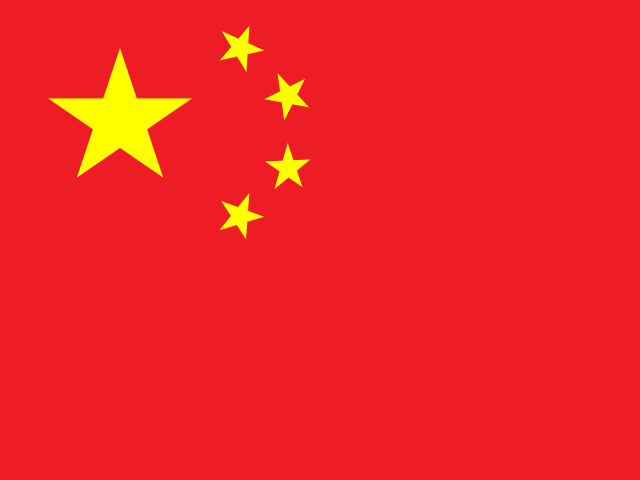
Beijing warned it would respond firmly if the EU adopts a proposed instrument modeled on U.S. Section 301. Possible Chinese countermeasures include anti-discrimination and supply-chain security investigations, threatening reciprocal restrictions and uncertainty for firms operating across European and Chinese markets.

Post-Brexit Trade Frictions Persist
Post-Brexit customs declarations, origin checks and sanitary controls add costs and delay EU shipments; one report cites an estimated 15% contraction in trade. Exporters, especially smaller firms and perishables handlers, face higher compliance burdens and weaker competitiveness.

Gas Production and Asset Approvals
Declining domestic gas output heightens the importance of upstream investment, yet proposed transfers require government approval. Cairo reportedly questioned a possible $1 billion BP asset sale on security and technical grounds, while BP’s drilling programme and new investment continue.
SUMED Route Capacity Pressure
Regional tensions have increased reliance on Egypt’s Suez Canal and 320-kilometre SUMED pipeline for crude moving from the Red Sea to the Mediterranean. Sidi Kerir loadings more than doubled from June, raising infrastructure-capacity and continuity questions.

Defense And Advanced-Technology Expansion
Turkey's defense exports reportedly exceed $10 billion, with officials promoting NATO-standard production and deeper U.S. cooperation, while acknowledging bilateral obstacles. AI infrastructure and digital transformation are also priorities, creating openings in advanced manufacturing and technology partnerships.
Defence Funding Access Remains Contested
Britain’s bid to join the EU’s SAFE defence-loan programme failed after disagreement over the required financial contribution, despite London’s pursuit of closer security ties. The episode signals that access to European defence financing may require costly policy commitments.

CPEC Investment Faces Security
Attacks in Balochistan threaten Chinese personnel, mines and transport links, while companies have cited unpaid dues of about $1.5 billion and regulatory friction. Security costs and uncertain project execution are slowing capital commitments across CPEC-related infrastructure and resource projects.
Investment Ties Remain Strategically Important
Despite de-risking rhetoric, major technology companies and manufacturers continue to depend on China’s suppliers, workforce and production ecosystem. A new bilateral investment board offers a channel to discuss barriers, but geopolitical tensions keep long-horizon commitments exposed.
Industrial Overcapacity Drives Exports
Reports describe subsidized Chinese production exceeding weak domestic demand, pushing exports of vehicles, solar products, batteries, steel and machinery into overseas markets. Price pressure and trade remedies may reshape competitor margins, market access and manufacturing investment.
Global Trade Diversification Falls Short
New global agreements have yet to offset EU trade friction: one analysis says the India deal adds at most 0.22% to GDP, while the EU accounts for 50.4% of UK trade and no US free-trade agreement exists. Diversification remains constrained.

Defense Spending Gains Priority
Despite broad restraint, the draft increases defense spending by about €6.5 billion, alongside additional allocations for justice, interior and research. This reprioritization may create procurement opportunities while redirecting public resources from other civilian programs and agencies.

AI Demand Supports Exporting Sectors
German electrical and digital exports to the EU rose 17% January–July, while suppliers of data-processing and electronics benefit from global data-center expansion. AI-linked demand offers opportunities, though exposure to external investment cycles remains significant for German businesses.

US Tariff Negotiations and Exposure
Negotiations are nearing a reciprocal trade deal after six rounds; the 2025 framework includes a 20% US tariff on many Vietnamese goods. With the US taking 32.1% of exports, final terms materially affect pricing and sourcing.

Technology Exports Raise Compliance Stakes
Exports of Mexican data-center and AI equipment are helping drive trade growth, while Washington seeks tighter origin and cybersecurity requirements, especially for Asian-linked inputs and investment. Technology firms may face higher compliance costs and scrutiny of supply-chain provenance.

Fragile U.S.-China Trade Truce
Washington and Beijing agreed tariff-preference recommendations covering $30 billion of non-sensitive goods each way, but their broader truce expires November 10. Companies should distinguish emerging trade lanes from unresolved disputes and prepare contingency sourcing for renewed duties.

Taiwan Drone Industry Scale-Up
Government plans NT$44.2 billion for drones through 2030, with output already NT$12.9 billion and more than 267 firms involved. New research, testing and production facilities aim to scale domestic supply, creating procurement and partnership opportunities.

Maritime Chokepoints Threaten Import Continuity
Reporting says 98% of Israeli imports arrive by sea, while Turkey–Libya maritime claims and Red Sea/Hormuz tensions threaten navigation. Businesses should stress-test port access, routing, cargo insurance and contingency inventories for critical inputs and exports.
Limited ECB Backstop for France
Bank of France Governor Emmanuel Moulin said ECB assistance is not justified and Paris must pass credible deficit cuts; reports warn French fiscal stress could affect euro-area stability. Investors should monitor bond-market contagion and limits to central-bank support.

Rial Weakness Raises Operating Costs
The rial reached record lows amid sanctions and export disruption, increasing import costs and intensifying Iran’s cost-of-living pressures. Reports also cite workers leaving jobs as wages lose purchasing power, creating added uncertainty around local procurement, compensation and workforce continuity.
Critical Minerals Drive Strategic Investment
South Africa is positioning platinum-group metals, vanadium, and rhodium as strategic supply-chain assets in U.S. engagement, while seeking local value addition. Disputes notwithstanding, proposed projects and continued mineral flows create openings for critical-minerals investors, processors, and downstream manufacturers.

Permitting And Investment Bottlenecks
Business leaders cite slow permitting, infrastructure gaps, limited growth capital and skills constraints across AI, quantum, mining, energy, defence and agri-food. A promised one-year review and fast-tracking could unlock investment, but execution will determine whether opportunities become operating capacity.

Rare-Earth Controls Threaten Supply
Beijing’s restrictions on rare earths and dual-use items aimed at Japanese firms are exposing input vulnerabilities. China controls about 90% of processing capacity; firms may need alternative sourcing, inventories, recycling and contingency plans as licensing uncertainty threatens production.
Investment Recovery Faces Brexit Drag
One assessment cited places UK investment 12–18% below a remain counterfactual by 2025, while new trade agreements offer modest offsets—the India deal’s estimated GDP uplift peaks at 0.22%. This constrains capital planning and productivity.
IMF Financing And Review
Pakistan’s review of the $7 billion Extended Fund Facility and Resilience and Sustainability Facility could unlock about $1.2 billion. Continued disbursements support external financing; review delays could tighten liquidity and complicate import payment planning.
Nearshoring’s Infrastructure Bottleneck
Analysts say capturing nearshoring gains requires private investment in energy, electricity, ports, water infrastructure, human capital and productivity. Constraints in these enabling assets could limit project execution, supply-chain capacity and medium-term growth despite trade integration.
Investment Incentives Meet Execution Risk
The investment summit produced nearly C$500 billion in commitments, while expanded immediate expensing is reported to lower the marginal effective tax rate on new investment from roughly 13% to 6.4%. Delivery hinges on converting announcements into built capacity.
Improving External Indicators
Official figures show goods-and-services exports rose 9.2% to $7.3 billion in July–August, remittances reached $7.3 billion, net FDI increased 24%, and the current-account deficit narrowed to $543 million, suggesting stronger—but still exposed—external buffers. [4vdU]
Rising Sovereign Funding Costs
French 10-year yields approached 4.8–5%, while the spread over Germany reached roughly 130 basis points; debt is projected at 121.7% of GDP in 2027. Higher financing costs may tighten credit conditions and raise hurdle rates across France.
US-South Africa Relations Deteriorate
Washington’s visa restrictions and threats of further measures, alongside Pretoria’s démarches, deepen bilateral friction. US officials warn that billions in prospective critical-mineral, energy and telecom investment could stall, raising policy, market-access and partnership uncertainty for multinationals.
Suez Recovery Remains Fragile
Canal activity rebounded in August 2026: revenue reached $567.1 million, up 56.7% year-on-year, with vessel numbers rising 27%. Yet renewed Bab al-Mandeb instability could reverse the recovery, complicating route planning for shippers and investors and Egypt’s foreign-exchange outlook.

Refinery And Fuel Disruptions
Ukrainian strikes on refineries, depots and ports have damaged domestic fuel availability and export capacity; Kyiv claimed repeated attacks disabled 45% of refining capacity. Fuel shortages and volatile prices raise operating costs for transport, agriculture and industrial users.

AI Demand Drives Chip Exports
September exports rose 83.5% to a record $120.9 billion, with semiconductor shipments reaching $60.3 billion, up 263% and nearly half of exports. AI infrastructure demand supports growth, but concentration heightens exposure to chip-cycle and customer-market disruptions.
Advanced Chip Controls Constrain Access
U.S. controls on advanced chips and manufacturing equipment shape market access, while summit talks yielded no reported relaxation. Nvidia, ASML and suppliers face constrained China sales; policy shifts can alter product eligibility, investment returns and incentives to develop domestic substitutes.
Corporate Tax Burden Uncertainty
The government proposes reducing the large-company surtax yield from about €8 billion to €5 billion, while total compulsory levies are forecast at 44.2% of GDP. Possible limits on employer contribution relief add uncertainty to labor costs and investment planning.